Elderberry vs Zinc vs Vitamin C: What Actually Works for Immunity? (2026 Guide)

Elderberry, zinc, or vitamin C—which actually works for colds and immunity? Discover science-backed benefits, comparisons, and what doctors recommend in this 2026 guide.

4/29/20266 min read

zarmis-zinc-vitamin-c-and-elderberry

Elderberry vs Zinc vs Vitamin C: What Actually Works?

When cold and flu season hits, most people reach for immune boosters like elderberry, zinc, or vitamin C. But here’s the critical question:

Do these supplements actually work—or are they just marketing hype?

This evidence-based guide breaks down what each ingredient really does, how effective it is, and which one delivers the most value for your immune system.

Quick Answer

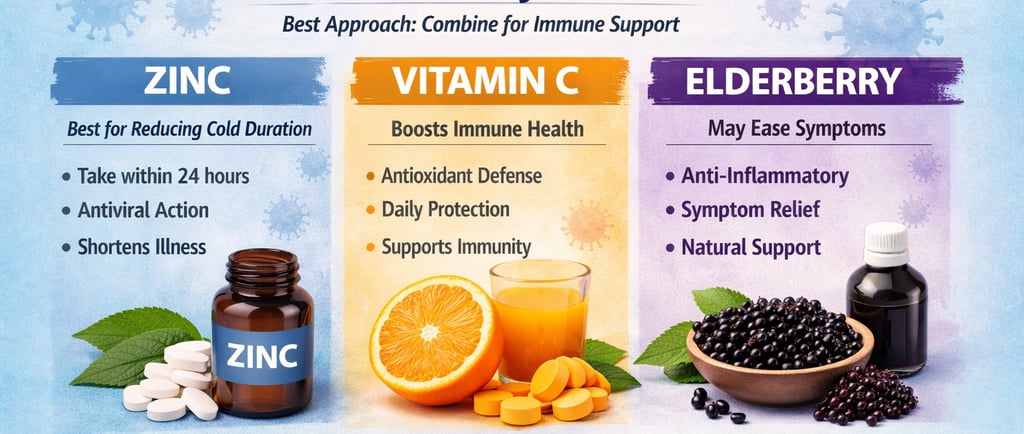
  • Zinc is the most effective supplement for colds, especially when taken within the first 24 hours of symptoms.

  • It works by blocking viral replication and shortening illness duration significantly.

  • Vitamin C supports overall immune function, but it does not act as a fast-acting treatment once symptoms begin.

  • It helps maintain immune resilience but has limited direct impact on active infections.

  • Elderberry may reduce symptom severity, but clinical evidence is inconsistent and product quality varies widely.

Best approach:

  • The most effective immune strategy is combining zinc + vitamin C, with elderberry as optional support.

  • This approach targets multiple immune pathways simultaneously.

  • It supports both innate and adaptive immunity.

  • It improves recovery while maintaining immune balance.

  • Avoid relying on a single supplement for optimal results.

What Actually Works (Doctor’s Perspective)

  • From a clinical standpoint, immune support should be strategic, not reactive.

  • Zinc acts as an acute intervention, meaning it works best at the onset of symptoms.

  • Vitamin C functions as foundational immune support, helping maintain daily immune readiness.

  • Elderberry serves as an adjunct, offering mild symptom relief rather than strong clinical impact.

  • No single supplement replaces a multi-layered immune strategy.

Highest-performing strategy includes:

  • Zinc for early-stage viral inhibition

  • Vitamin C for baseline immune defense

  • Optional elderberry for symptom comfort and recovery support

  • Vitamin D3 for immune regulation and deficiency correction

  • Lifestyle optimization including sleep, hydration, and stress management

Common Mistakes People Make

  • Taking zinc too late, after symptoms peak, reduces its effectiveness significantly.

  • Overusing vitamin C, expecting instant results, leads to unrealistic expectations.

  • Relying only on natural remedies like elderberry, without clinical support, limits outcomes.

  • Ignoring sleep, stress, and hydration, which are critical for immune function.

  • Using low-quality supplements with poor absorption or incorrect dosing.

Additional critical errors:

  • Not maintaining consistent daily immune support

  • Choosing products without standardized active ingredients

  • Ignoring timing, which is crucial for zinc effectiveness

  • Expecting prevention instead of focusing on immune efficiency

  • Not combining nutrients for synergistic effects

When Should You Take Each?

At First Sign of Symptoms:

  • Take zinc within the first 24 hours for maximum effectiveness

  • Helps reduce cold duration and viral activity

  • Best used in lozenge or fast-absorbing forms

  • Works directly in the throat where viruses replicate

  • Critical timing window determines effectiveness

Daily Immune Maintenance:

  • Take vitamin C regularly to support immune defense and antioxidant protection

  • Helps maintain white blood cell function

  • Supports skin and mucosal barriers against pathogens

  • Works best when taken consistently over time

  • Ideal for long-term immune resilience

During Illness Recovery:

  • Elderberry may help reduce symptom severity and inflammation

  • Supports recovery phase rather than prevention

  • Best used as a complement, not a primary treatment

  • May help with fatigue and immune recovery

  • Choose standardized extracts for better results

Final Verdict

  • If choosing only one supplement, zinc is the most effective for colds and immune response.

  • It has the strongest clinical evidence for reducing illness duration.

  • Vitamin C remains essential for daily immune support, not rapid treatment.

  • Elderberry provides mild support but should not be relied on alone.

  • The best results come from a combined, evidence-based approach.

Optimal immune strategy:

  • Zinc for acute immune response

  • Vitamin C for baseline protection

  • Elderberry as optional recovery support

  • Add vitamin D3 and lifestyle optimization for full effect

  • Focus on consistency, timing, and quality supplementation

How the Immune System Actually Works

  • The immune system is not something you “boost”—it must be balanced and regulated.

  • It operates through a complex network of cells, signals, and responses.

  • Overactivation can be just as harmful as underperformance.

  • The goal is immune efficiency, not overstimulation.

  • Proper support enhances communication between immune cells.

Innate Immunity (Immediate Response):

  • First line of defense against viruses and bacteria

  • Includes macrophages, neutrophils, and NK cells

  • Responds rapidly but non-specifically

  • Works within hours of pathogen exposure

  • Critical for early infection control

Adaptive Immunity (Targeted Response):

  • Involves T-cells and B-cells

  • Develops specific responses to pathogens

  • Creates immune memory for future protection

  • Slower response but highly targeted

  • Essential for long-term immunity

Key Insight:

  • Effective immunity depends on coordination between innate and adaptive systems

  • Nutrients like zinc and vitamin C help optimize this communication

  • Poor lifestyle habits disrupt immune balance

  • Supplements should support—not override—natural processes

  • Immune strength equals efficiency, not intensity

Vitamin C – The Classic Immune Support

What It Does:

  • Supports white blood cell production and function

  • Acts as a powerful antioxidant

  • Protects cells from oxidative stress

  • Strengthens skin and mucosal barriers

  • Supports collagen production and tissue repair

What the Research Says:

  • May reduce cold duration by approximately 8–10%

  • Does not significantly prevent colds in most people

  • More effective in individuals under physical or environmental stress

  • Works better as a preventive nutrient than a treatment

  • Benefits increase with consistent daily intake

Bottom Line:

  • Vitamin C is essential for baseline immune support

  • It helps maintain overall immune readiness

  • It is not a fast-acting solution during illness

  • Works best when combined with other immune nutrients

  • Should be part of a daily health routine

Zinc – The Most Clinically Effective Option

What It Does:

  • Supports immune cell signaling and function

  • Inhibits viral replication directly

  • Reduces inflammation during infection

  • Enhances T-cell and natural killer cell activity

  • Plays a key role in immune regulation

What the Research Says:

  • Can reduce cold duration by up to 33%

  • Most effective when taken early in infection

  • Works directly against viral activity in the upper respiratory tract

  • Supported by strong clinical evidence

  • Benefits depend heavily on timing and dosage

Key Clinical Insight:

  • Zinc lozenges provide localized antiviral effects in the throat

  • Faster absorption compared to capsules

  • More effective for respiratory infections

  • Should be taken at symptom onset

  • Avoid excessive long-term use without guidance

Bottom Line:

  • Zinc is the most effective supplement for acute immune support

  • Works best when used early and correctly

  • Offers direct antiviral benefits

  • Strongest evidence among immune supplements

  • Essential for rapid immune response

Elderberry – Natural but Overhyped?

What It Does:

  • Contains anthocyanins with antioxidant properties

  • Supports immune response through anti-inflammatory effects

  • May have mild antiviral activity

  • Helps reduce oxidative stress

  • Supports overall immune balance

What the Research Says:

  • Some studies show reduced flu symptom duration

  • Evidence is limited and varies between studies

  • Not consistently effective across populations

  • Benefits depend on formulation and dosage

  • More supportive than clinically definitive

Practical Considerations:

  • Product quality varies widely

  • Standardization is often inconsistent

  • Syrups and extracts differ in potency

  • Not all products deliver the same benefits

  • Choose clinically formulated products

Bottom Line:

  • Elderberry may help reduce symptoms

  • Not as reliable as zinc for treatment

  • Best used as a complementary supplement

  • Works well during recovery phases

  • Should not replace evidence-based options

Frequently Asked Questions (FAQ)

What works best for a cold: zinc, vitamin C, or elderberry?

Zinc works best for reducing cold duration, especially when taken within the first 24 hours of symptoms. It directly interferes with viral replication and supports immune response. Vitamin C supports general immunity, while elderberry may help reduce symptom severity but is less consistent in clinical evidence.

Does vitamin C prevent colds?

Vitamin C does not reliably prevent colds in the general population. However, it may slightly reduce the duration and severity of symptoms when taken regularly. Its primary benefit is maintaining immune function rather than acting as a treatment.

How fast does zinc work for a cold?

Zinc works best when taken within 24 hours of symptom onset. Early use can significantly reduce the duration and severity of a cold. Delayed intake reduces its effectiveness, making timing critical.

Is elderberry scientifically proven?

Elderberry has some supportive evidence showing it may reduce flu and cold symptoms. However, results are inconsistent across studies, and more large-scale research is needed. It is best used as a complementary supplement rather than a primary treatment.

Can you take zinc and vitamin C together?

Yes, zinc and vitamin C can be taken together safely and are often combined in immune support supplements. They work through complementary mechanisms to support immune function. This combination is commonly recommended during cold and flu season.

How much zinc should I take for a cold?

Typical daily zinc doses range from 15–30 mg for general immune support. During a cold, short-term higher doses may be used under medical guidance. Long-term excessive intake should be avoided due to potential side effects.

Is elderberry safe to take daily?

Elderberry is generally safe when taken in standardized, commercially prepared forms. Raw or unprocessed elderberry should be avoided due to potential toxicity. Daily use is typically well tolerated when following recommended dosages.

Does vitamin C boost immunity instantly?

Vitamin C does not provide an instant immune boost. It supports immune function over time by improving antioxidant protection and white blood cell activity. Consistent intake is key for long-term benefits.

What is the fastest way to recover from a cold?

The fastest way to recover includes early zinc supplementation, proper hydration, and adequate rest. Supporting your body with balanced nutrition also plays a critical role. Managing stress and getting quality sleep can further speed recovery.

Are immune boosters actually necessary?

Immune boosters can help support immune function, especially during periods of stress or illness. However, they are not a replacement for healthy lifestyle habits. Proper sleep, nutrition, and stress management remain the foundation of strong immunity.

zinc-for-cold-relief-benefits